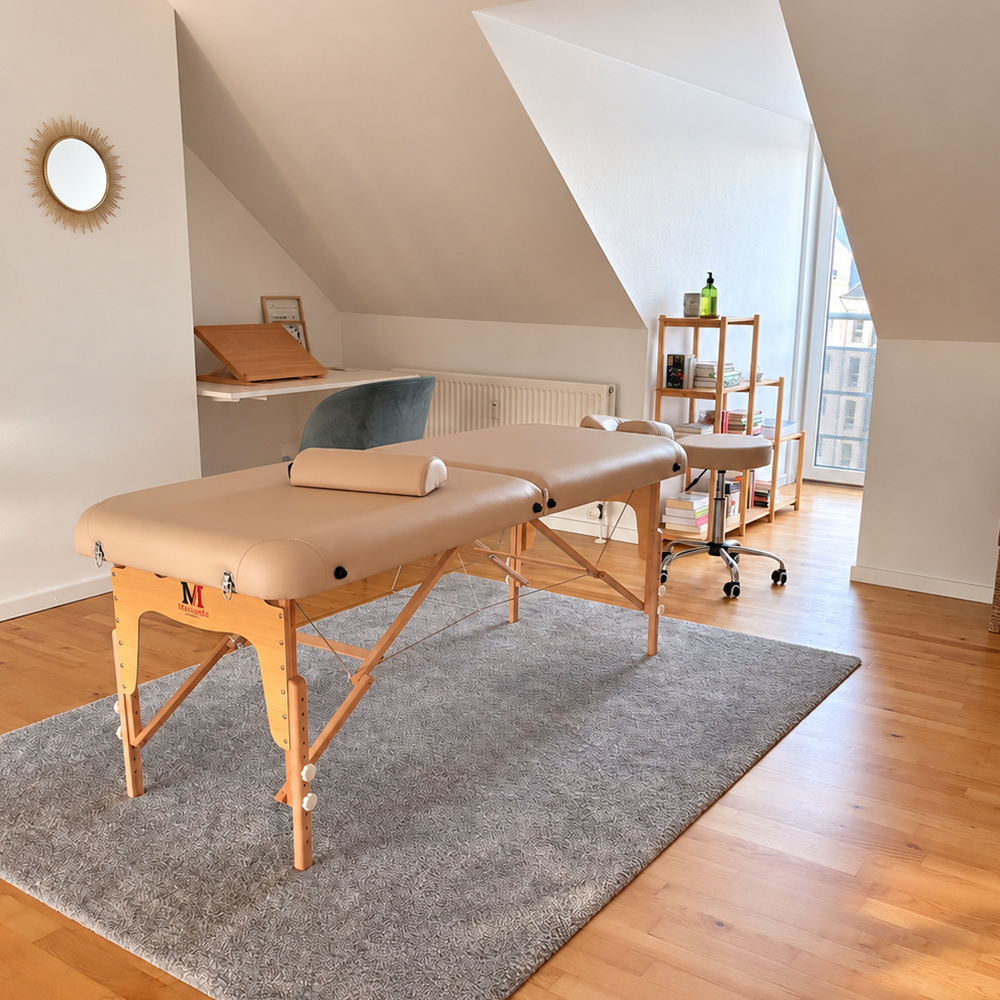




A tension headache from desk work usually feels like a dull, pressing band around the forehead or the back of the head, often building in the afternoon after hours at a screen.
It often gets worse after a week with deadlines and too little sleep.
I'm Vica, and I see this a lot in my studio in Christianshavn. Many of the people who come to me spend their days at a desk, on a bike commute, and then back at a screen. The head often pays for what the neck and shoulders are holding.
Most desk headaches come from neck, shoulder and jaw muscles that hold the head forward for too long, made worse by stress, few breaks and shallow breathing.
When you lean towards a screen, the head moves forward and the muscles at the back of the neck have to hold it there all day.
Things I often see behind it:
Yes, for many people massage helps tension headaches come less often or feel softer, especially when tight neck and shoulder muscles are part of the cause. Research on soft tissue work is promising but still limited, so I see it as one helpful tool, not a cure.
My clients notice it most when the neck and shoulders are looked after regularly. Massage can help the muscles let go, the breath drop and the nervous system calm down. I can't promise it will make headaches disappear, and it is not a diagnosis.
A headache that is new, very strong, keeps getting worse, or comes with changes in vision, speech, numbness or fever needs a doctor first, and sometimes right away. If you have migraines that are already diagnosed, tell me, so we can adjust the session. Please see a doctor first if the pain came after a fall or accident, if it is sharp, sudden or getting worse quickly, or if you notice numbness, weakness, fever or anything that simply feels wrong. I am happy to support you, and I will always tell you honestly when massage is not the first thing you need.
I treat desk headaches by working slowly on the base of the skull, the neck, the shoulders, the jaw and the chest.
We start by talking. I want to know how your days look, if you take breaks, and where the pain usually starts.
On the table I work with detail and patience. I combine deep tissue, Zen Shiatsu and, if you like, a little Reiki at the end. I often use grounded pressure, sometimes with my elbows, but I never lose the connection, so you feel held the whole time.
The areas I usually focus on:
[Client story from Vica needed]
The quickest relief at your desk comes from small breaks every hour, a raised screen, a relaxed jaw and a few slow belly breaths when the band starts.
Small things, repeated often, help more than one big effort.
For tension headaches I usually suggest a steady rhythm: once a week if we work 45 minutes, or every two weeks if we work 60 minutes.
Every body is different, so I can't promise a number, but I see again and again that a rhythm like this works better than a single session.
When you come once a month, the body has often forgotten the last session and the tension has more room to come back.
Many people start with a short series and then space the sessions out as they feel better. If you know you will come regularly, my loyalty tickets let you save on every visit and book whenever it suits you.
It often helps people feel fewer and softer headaches, especially when tension in the neck and shoulders is part of the story. It is not a cure, and new or unusual headaches should be checked by a doctor.
Tension headaches usually feel like a steady, pressing band on both sides of the head without throbbing or nausea. A doctor can tell you for sure, and a new or very strong headache should always be checked.
If it is a normal tension headache, many people find the session soothing. If it is a strong migraine attack, it is usually better to wait until it has passed.
Yes, a clenched jaw is often part of the picture. If you want, I work gently on the jaw muscles and the temples, and we always agree on it first.